Cardiomegaly and congestive heart failure
Target retrieval, structure acquisition, generation, screening, lead optimization, and retrosynthesis.
Research evidence index
This index routes readers to the evidence-bearing chapters of FROGENT and every product site. Scientific evidence, manuscript positioning, and company-level portfolio language remain separate layers.
01 / FROGENT manuscript evidence
The supplied manuscript compares FROGENT with six progressively capable baselines across task-specific benchmarks and presents three computational design case studies.
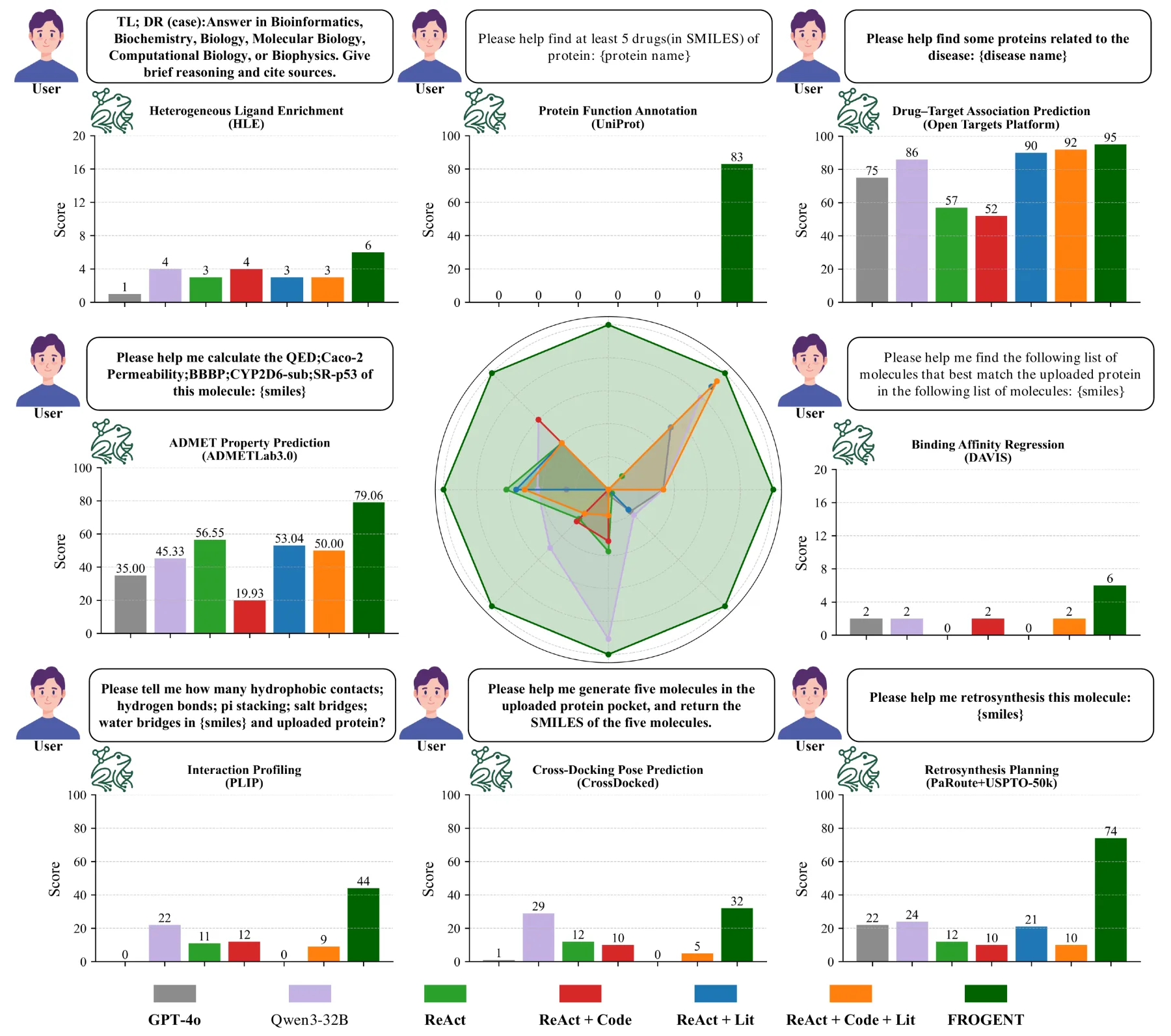
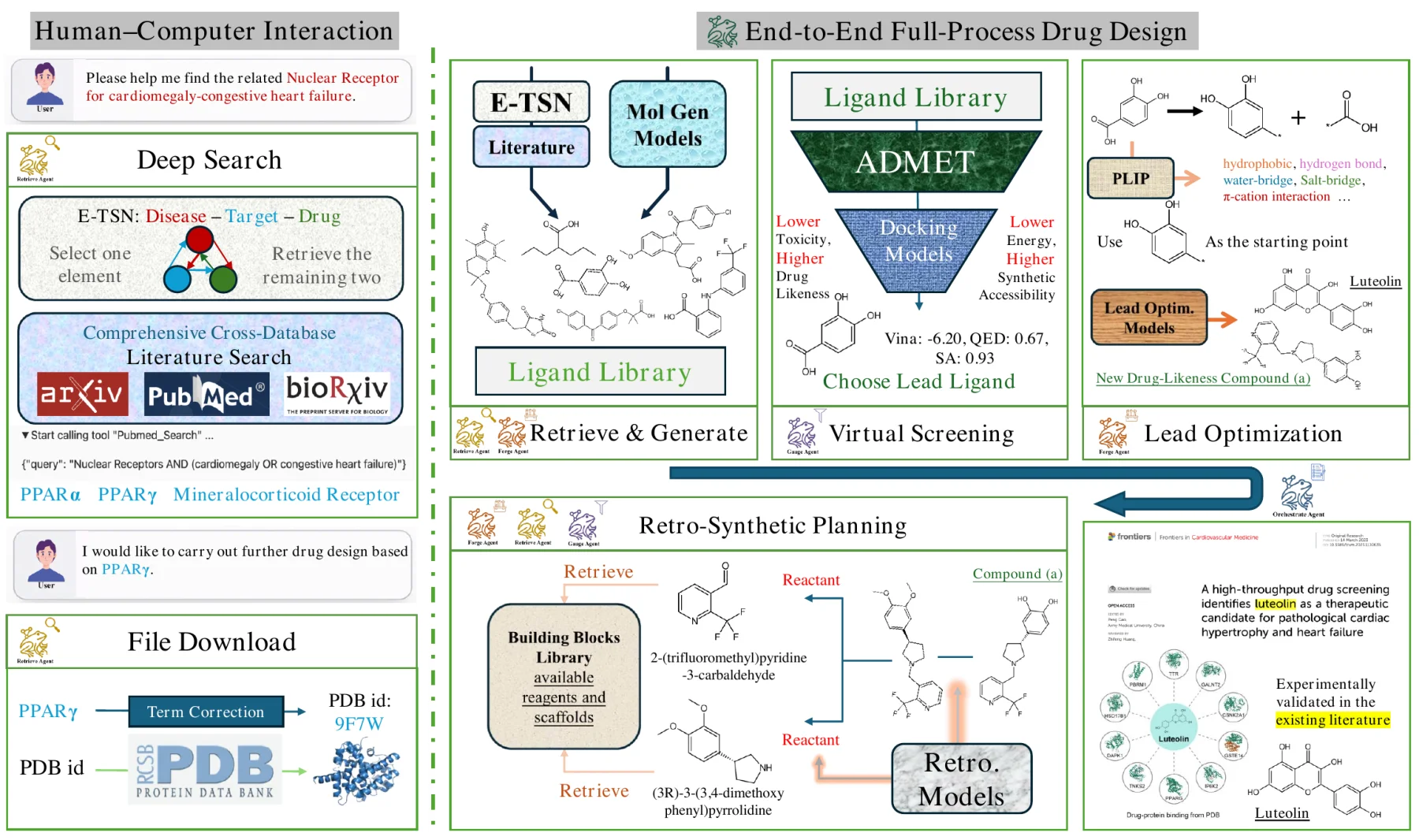
Target retrieval, structure acquisition, generation, screening, lead optimization, and retrosynthesis.
A design-evaluate-refine loop for peptide candidates under a consistent in silico protocol.
Structure analysis, analogue generation, evaluation, and synthesis-path repair using retrieved evidence.
Evidence boundary. These entries summarize the supplied manuscript. Computational evaluation does not establish experimental efficacy, safety, affinity, or clinical performance.
02 / Product evidence
Scientific Design Engine
Scope. All-target campaign, AML1–ETO9a pocket study, and OpenBind diagnostics.
Evidence focus. Coverage ledger, ten-round signals, contact fingerprint, curated chemistry, backend stability, state aggregation, retrieval gap, and limitations.
Scientific Design Engine
Scope. Fixed-anchor degrader design and archived computational studies.
Evidence focus. B5/C0 anchors, linker geometry, constrained search, restricted docking, 100-search acceptance record, weighting variants, replay validity, and source boundaries.
Scientific Design Engine
Scope. Structure-feedback peptide design for xanthine oxidase (XOD).
Evidence focus. Reward decomposition, fixed-budget design, candidate curation, interface evidence, reported activity context, and three explicit evidence limits.
Scientific Design Engine
Scope. Structure-constrained internal ribosome entry site (IRES) prioritization.
Evidence focus. CrPV, TSV, and IAPV fixed positions, secondary-structure maps, resolved-chain coverage, candidate comparisons, source links, and limitations.
Scientific Design Engine
Scope. Cell-type-aware regulatory DNA design across enhancer and yeast-promoter evaluations.
Evidence focus. Reward difference, transcription factor binding site motif correlation, generation-budget sensitivity, diversity comparison, provenance, tables, and CSV download.
Scientific Agent
Scope. Evidence-aware peptide optimization and review contracts.
Evidence focus. Runtime components, ten-stage workflow, executable capabilities, tools, governed memory, trace ledger, three reviewers, task contract, evidence, and test plans.