Orchestrate Agent
Plans the task graph, delegates work, tracks state, and controls feedback loops.
Flagship platform / FROGENT
FROGENT is EasternDawn's full-process multi-agent drug design platform. Four collaborating agents plan, retrieve, generate, evaluate, and refine work through a common project state and a Model Context Protocol (MCP)-connected capability layer.
01 / Abstract
FROGENT turns a high-level goal into a task graph and keeps retrieved evidence, candidate structures, scores, artifacts, failures, and agent handoffs in shared context. Specialized engines can then contribute modality-specific work without losing the scientific question that motivated it.
To our knowledge, the first multi-agent drug design framework that integrates and automates end-to-end discovery workflows for both small-molecule and peptide therapeutics.
Evidence boundary. The priority statement is preserved exactly from the supplied manuscript. Benchmark and case-study results describe computational workflows and do not establish experimental efficacy, safety, affinity, or clinical performance.
02 / Architecture
The architecture separates responsibility while preserving a common evidence trail. Each agent can call models, databases, tools, and evaluators through a shared MCP interface.
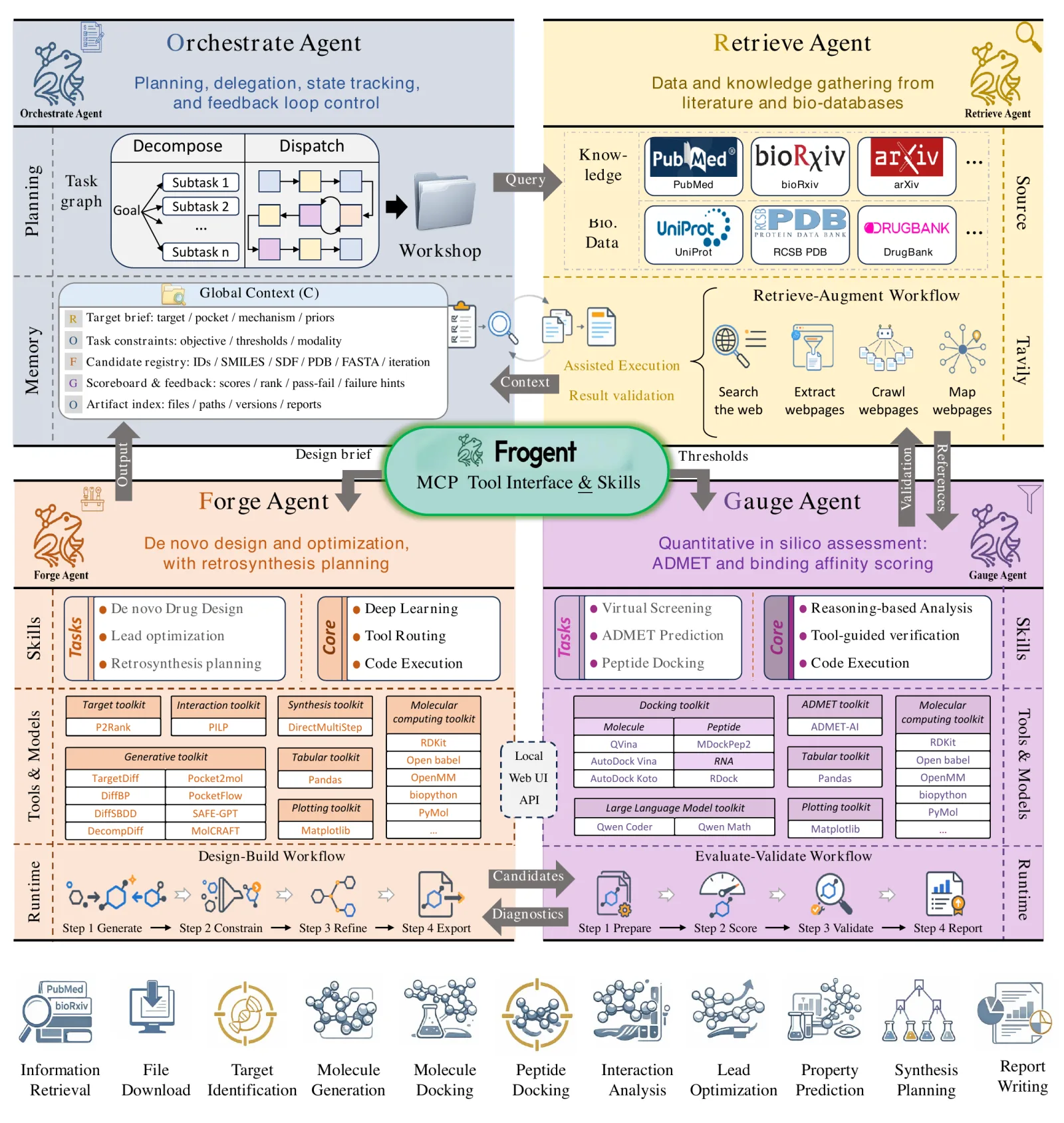
Plans the task graph, delegates work, tracks state, and controls feedback loops.
Gathers literature, database records, structures, and project evidence while preserving provenance.
Generates and optimizes candidates, then connects design decisions to synthesis planning.
Scores candidates, exposes diagnostics, and returns evaluation evidence to the next decision.
03 / End-to-end workflow
Record the scientific goal, modality, constraints, thresholds, and human decision points.
Collect task-relevant evidence and retain the source attached to each claim or artifact.
Generate candidates through modality-specific engines under explicit task constraints.
Run quantitative evaluators, preserve component scores, and expose failure diagnostics.
Return evidence to the shared context so the next proposal responds to the current record.
Assemble ranked candidates, synthesis plans, provenance, limitations, and a consolidated report.
04 / Connected engines and agents
Each product retains its own method, experiments, evidence, limitations, and visual identity while contributing a focused capability to the broader workflow.
All-target molecular generation and target-memory-guided search.
Targeted degradationFixed-anchor, structure-aware degrader design.
PeptideStructure-feedback peptide design demonstrated for xanthine oxidase (XOD).
RNAStructure-constrained RNA prioritization.
DNACell-type-aware regulatory DNA design.
Scientific agentEvidence-aware peptide optimization and review.
05 / Evaluation and limits
The supplied manuscript reports comparisons with six progressively capable baselines across eight benchmark families and documents three end-to-end computational design case studies. Task definitions and scoring scales remain specific to each evaluation.
Inspect the FROGENT evidence index →
Limitations. Automated coordination can improve coverage and traceability while still inheriting model error, database gaps, evaluator approximation, and task-definition bias. Consequential decisions require expert review and prospective experimental validation.