Combinatorial middle design
Zero, one, or two linker fragments followed by one motif fragment create many assemblies with distinct graph and geometry consequences.
Proteolysis-targeting chimera (PROTAC) · fixed anchors · generative middle
Scientific Design Engine · Targeted protein degradation
TrioPROTAC frames degrader design as a constrained middle-generation problem. A bromodomain-containing protein 4 (BRD4) warhead and an E3 ubiquitin ligase-side tail remain fixed while a fragment policy, hard chemical constraints, Monte Carlo tree search (MCTS), and restricted docking explore the linker–motif region.
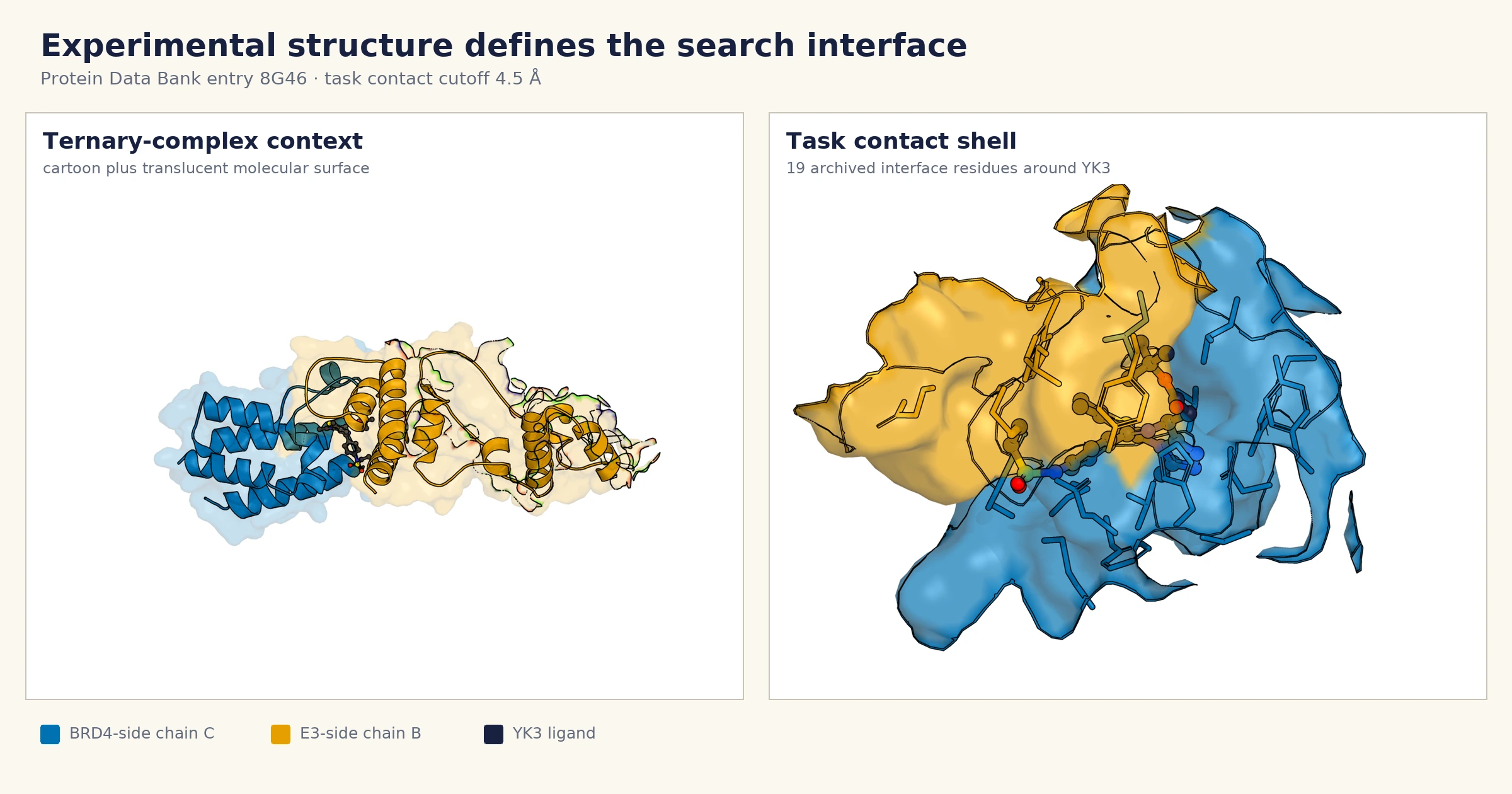
The professional molecular rendering connects the degrader task to both protein partners, the YK3 ligand, and the archived 4.5 Å contact shell.
Evidence boundary. Experimental coordinates supply the reference context; generated-candidate ternary stability is unmeasured.01 / Abstract and project definition
Proteolysis-targeting chimera (PROTAC) design couples two binding anchors through a middle whose chemistry and geometry strongly influence the assembled molecule. TrioPROTAC preserves the target-facing and E3-side anchors, generates only the linker–motif middle, appends the fixed tail, and evaluates the complete molecule in a structure-aware search.
The method keeps molecular assembly, search constraints, docking geometry, and evidence provenance together. The structural reference is Protein Data Bank (PDB) entry 8G46. Archived experiments cover fixed-anchor acceptance, reference-set neighborhood and exact recovery, paired reward-weight screens, docking summaries, and model-generation quality. Each result retains its historical protocol boundary.
02 / Scientific problem
Linker fragments, motif choices, ordering, connectivity, flexibility, and terminal assembly create a large chemical space. Many sequences cannot form a valid two-ended molecule; others violate linker geometry or lose the conserved warhead frame during structural evaluation. TrioPROTAC narrows the search before expensive docking and keeps rejection causes visible.
Zero, one, or two linker fragments followed by one motif fragment create many assemblies with distinct graph and geometry consequences.
Partial branches must retain connectable fragments and terminal assemblies must satisfy fragment count, motif, tail-bond, and flexibility rules.
Restricted docking locks the conserved core while torsions outside that core remain available to search.
03 / Method overview
The input task defines the BRD4-facing warhead, E3-side tail, target structure, and allowed middle length. A real-data fragment model proposes linker and motif sequences. Chemical constraints reject invalid partial and terminal branches. The final molecule is aligned to the conserved core and evaluated with property, bridge, interface, and restricted-docking signals inside MCTS.
Defines fixed anchors, target structure, linker allowance, connectivity rules, and the structural context for evaluation.
Output · Fixed molecular boundaryProposes the middle as a sequence of linker fragments followed by one motif fragment; the fixed tail is appended afterward.
Output · Linker–motif sequenceEnforces connectability, fragment count, terminal assembly, linker geometry, motif descriptors, and whole-molecule flexibility.
Output · Chemically connected assemblyAligns the conserved core, locks that rigid component, and explores eligible torsions outside the core during restricted docking.
Output · Pose and structural diagnostics04 / Architecture
Inputs, operations, evidence, and outputs stay named so the source of each decision can be reviewed.
A target assignment provides both fixed anchors, the target structure, and allowed middle complexity.
→The fragment model proposes only the variable middle under the learned real-data chemical prior.
→Hard rules remove branches that cannot connect or violate task-defined molecular boundaries.
→The conserved warhead frame stays locked while eligible outside-core torsions and interface signals are evaluated.
05 / End-to-end workflow
Each stage consumes a bounded object and leaves a reviewable artifact for the next stage.
Load the assignment and place the fixed BRD4-facing warhead in the initial fragment prompt.
Sample linker and motif fragments from the learned policy under the allowed middle length.
Reject branches that violate connectability, fragment count, linker, motif, or terminal assembly rules.
Append the fixed E3-side tail and reconstruct a complete molecule.
Combine molecular-property, middle-design, bridge, interface, and restricted-docking signals.
Back-propagate reward, deduplicate terminal molecules, and retain one final candidate per assignment.
06 / Experimental design
Every study below describes what was varied, what was measured, and where interpretation must stop.
The historical formal study evaluated 50 B-series and 50 C-series assignments under archived acceptance rules. The current page preserves the result with its original synthetic-accessibility gate clearly labeled as historical.
Generated molecules were compared with an 18-molecule reference panel using Morgan fingerprints and canonical Simplified Molecular Input Line Entry System matching. A later development campaign explicitly tracked this panel, limiting independence.
Seven archived model states were each evaluated with 1,000 generated samples. Validity, uniqueness among valid molecules, novelty, and property-distribution distance were compared under the project composite rule.
07 / Results and evidence
Quantitative summaries, structural views, and scientific interpretation remain separate layers.
Archived rules with a synthetic-accessibility terminal gate
At least 0.8 Morgan-fingerprint similarity in the expanded development snapshot
C0 recovered by canonical molecular-string matching
C5 in a five-recorded-score molecular summary, kcal/mol
The formal 100-assignment study recorded 84 accepted outcomes: 39 of 50 B-series and 45 of 50 C-series assignments. A synthetic-accessibility terminal gate used by that study has since been removed from the current evaluation logic.
Boundary. The 84% value describes one archived protocol and is not a forecast of current acceptance.The expanded development snapshot reached a mean best-neighbor similarity of 0.9005 and placed 17 of 18 references at or above 0.8 similarity, while canonical exact matching recovered only C0.
Boundary. Two-dimensional fingerprint similarity does not establish structural equivalence, biological activity, or independent validation.Protein Data Bank entry 8G46 provides the experimental ternary-complex coordinate context. The task tracks a 19-residue contact shell around the YK3 ligand and evaluates bridge and interface feasibility alongside restricted docking.
Boundary. The reference complex defines context; it does not show a generated candidate reproducing the experimental ternary complex.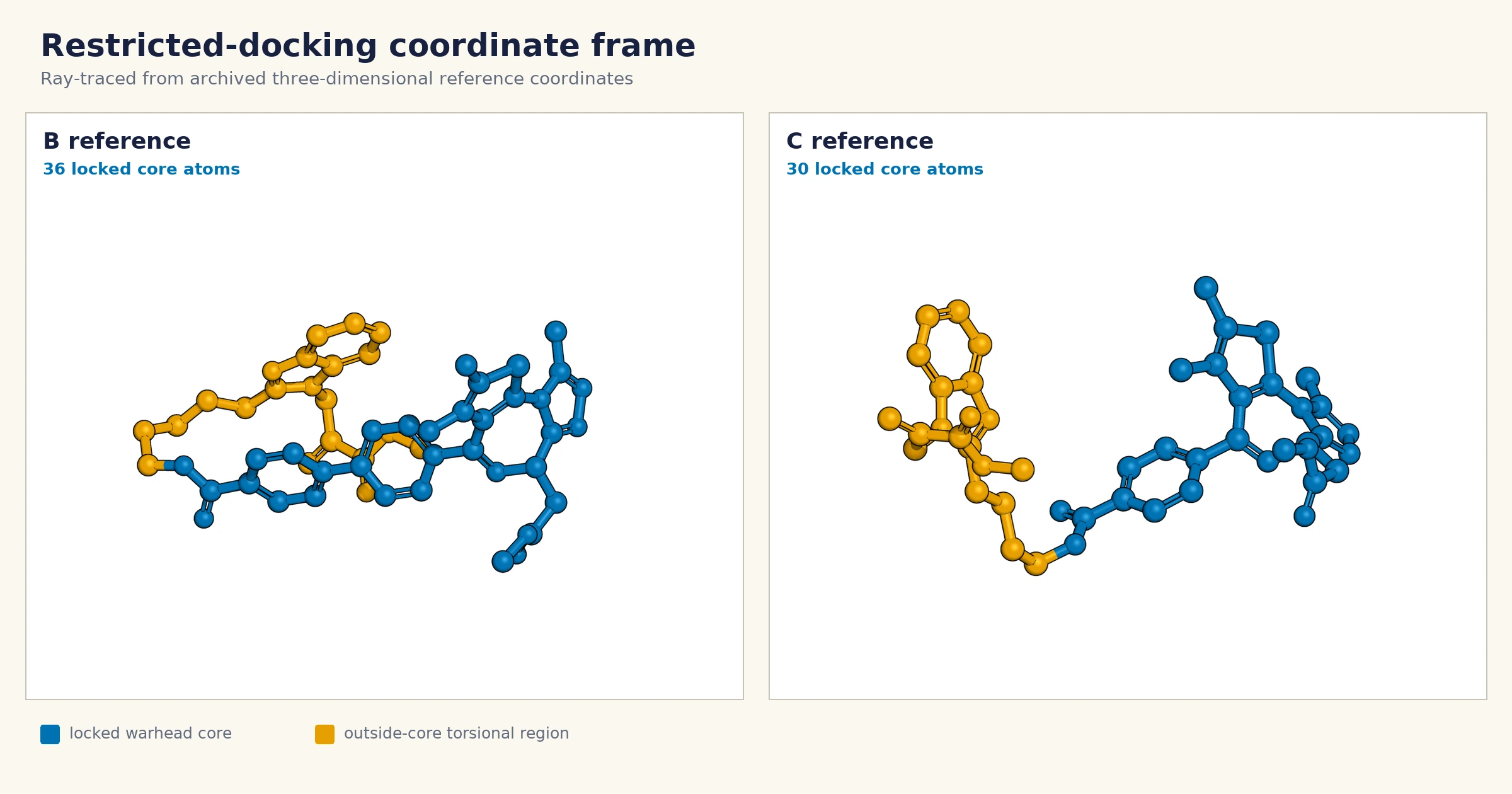
The B task locks a 36-atom warhead core and the C task locks a 30-atom core, preserving the target-facing coordinate frame during docking.
Evidence boundary. These are reference coordinate frames and do not demonstrate generated-pose stability or degradation activity.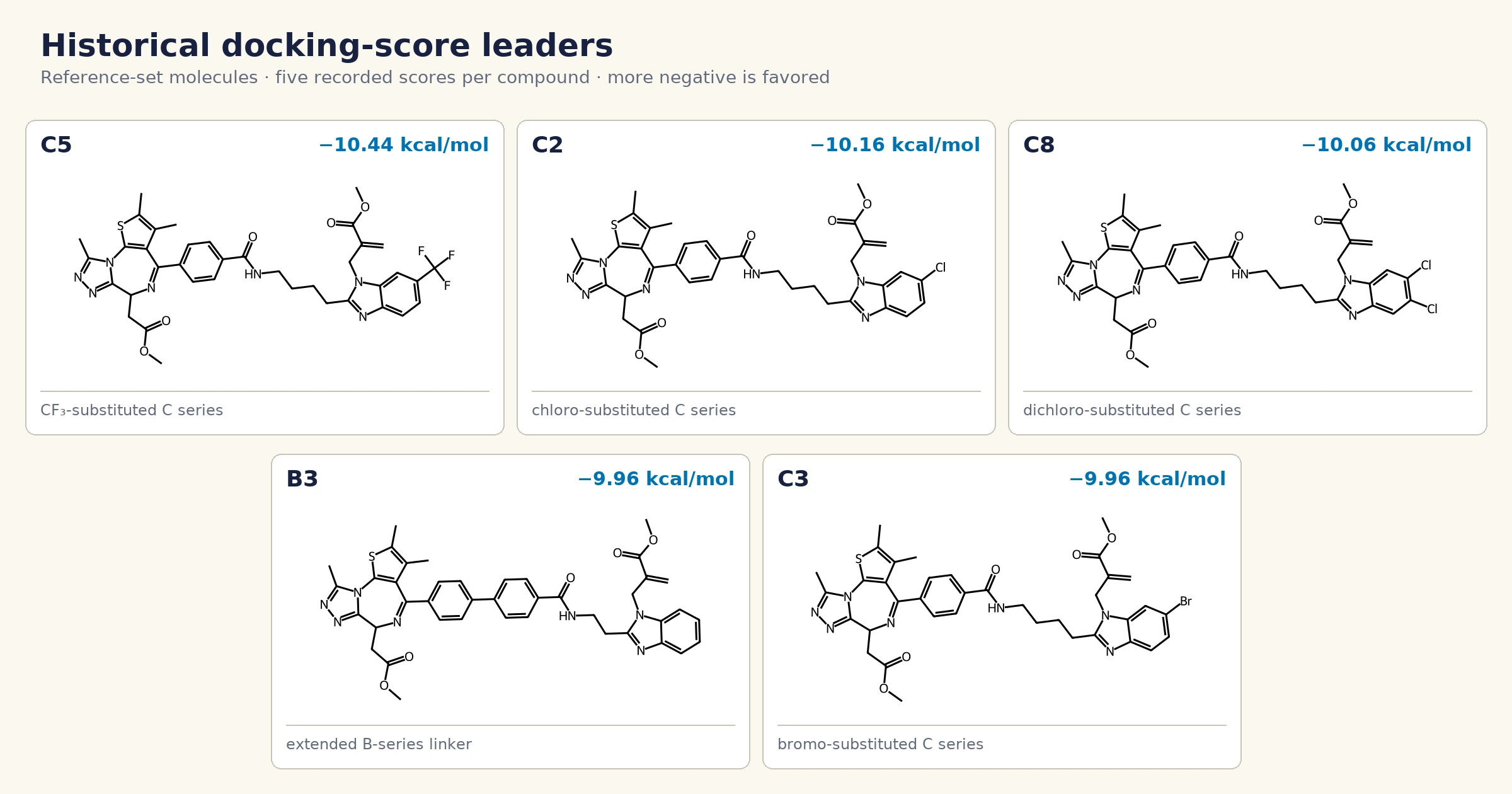
The panel shows the complete reference-set molecules behind the archived five-recorded-score ranking.
Evidence boundary. Vina scores are computational predictions and do not establish affinity, degradation, or efficacy.Reading key
08 / Limitations and provenance
Metrics remain attached to their archived protocol, sample count, and known limitations. Current product language does not convert development evidence into an experimental claim.
Acceptance counts from the archived fixed-anchor study include a terminal gate that is absent from current evaluation logic.
The expanded reference campaign tracked the 18-molecule panel as an explicit objective, so its coverage cannot be treated as independent validation.
No in vitro degradation, ternary-complex cooperativity, cellular activity, animal efficacy, or clinical performance is established by these records.